Selling by the metre, kilo, or capsule
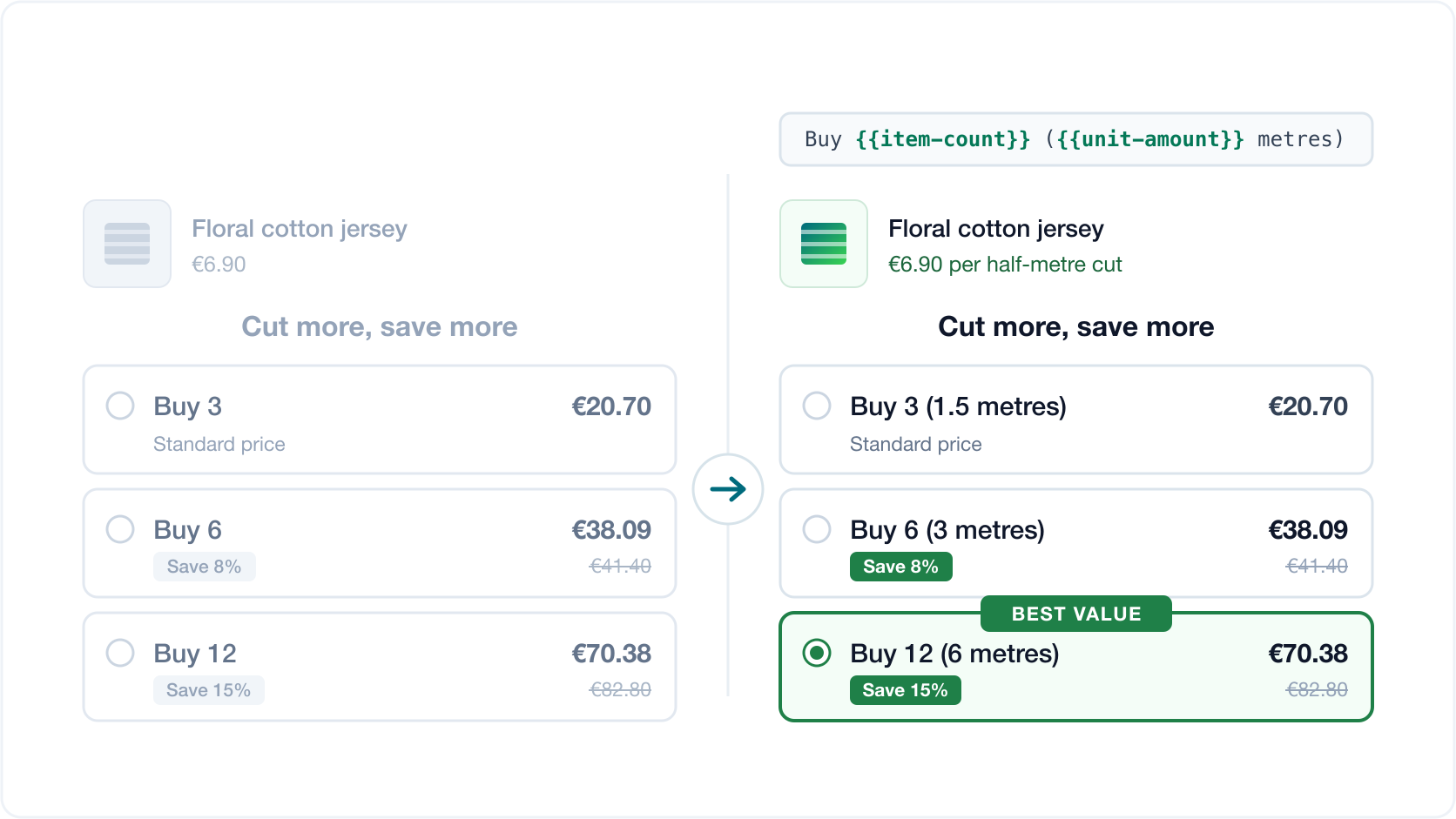
One item in your store is half a metre of fabric. Or a pack of eighty coffee capsules. Or a two-kilo bag. Your quantity tiers count items, because that is what a store counts. Your shopper counts metres, capsules and kilos, because that is what they came for. This post is about closing that gap, and it is for you if you sell:
- By length. Fabric, ribbon, webbing, vinyl, cable, trim: sold in cuts, bought in metres.
- By the pack. Capsules, pods, tea bags, cans, sachets: sold as a box, bought as a count.
- By weight or volume. Coffee, pet food, detergent, refills: sold as a bag, bought in kilos or litres.
- By how long it lasts. Servings, meals, doses, days of supply: sold as a tub, bought as a month.
Quick test, and it is a reliable one: if your product description contains a conversion table, this is about you.
The conversion table in the description
A fabric shop sells jersey the way good fabric shops do: in half-metre cuts. One item in the store is 0.5 m. And because they know exactly what is going through their shoppers’ heads, they wrote the conversion out by hand, into the product description.
Quantity 1 = 0.5 m. Quantity 2 = 1 m. Quantity 3 = 1.5 m. Quantity 4 = 2 m. Etc etc.
That is a merchant who understands their customer better than their tools do. They knew the number on the button was not the number in the shopper’s head, so they bridged it themselves. It works. It is also work nobody should have to do twice, and it sits well below the buy button, where fewer people read it than any of us would like.
So the better instinct, and the one we see constantly, is to move the unit up into the offer itself: Buy 10 (5 metres). That is exactly right. It just quietly stops being true the moment shoppers can pick their own quantity.
Where the hand-typed total breaks
Selling by length or by weight is precisely the case where a shopper needs to choose their own quantity, so this comes up immediately. They take 12 cuts, the tier still promises 5 metres, the cart holds 6. Nothing about that is carelessness. A number typed once cannot follow a number the shopper is still choosing.
One field, one placeholder
So we added exactly one thing to a bundle: Amount per item. 0.5 for a half-metre cut. 80 for a pack of 80 capsules. 2 for a two-kilo bag. And one placeholder, {{unit-amount}}, which is items × that number, and which follows the shopper’s quantity the way {{item-count}} already does.
It renders digits and nothing else. No noun, no pluralisation, no unit vocabulary invented by us and shipped in every language we support. You write the word, so the wording, the grammar and the language stay yours. A German store types ({{unit-amount}} Meter) and it reads like the store wrote it, because the store did.
Buy {{item-count}} ({{unit-amount}} metres)
Floral cotton jersey
€6.90 per half-metre cut
Why this sells, and not just why it is correct
The unit is not a nicety. It is the number people actually compare with, which is why EU law has required traders to show the unit price beside the selling price since 1998. And presenting it well moves purchases: in a supermarket field experiment, Russo (1977) found that making per-unit prices easy to read measurably shifted what shoppers put in the basket, and concluded the benefit to shoppers and retailers alike justified the cost of showing it.
- Value becomes comparable. “Buy 4” is a fact about your warehouse. “320 capsules” is a number your shopper can hold up against the supermarket shelf, and win.
- The big tier becomes legible. “Buy 6” asks for a leap of faith. “12 kg” is a decision about how long the dog is fed for, and that is a decision people already know how to make.
- Nobody has to multiply. A tier that demands arithmetic gets skipped, not calculated. Doing the multiplication for the shopper is the cheapest conversion work on the page.
Set Amount per item once and write the noun the way you would say it out loud. MaxValue AI Bundles does the multiplication from there, in your unit, in your words.